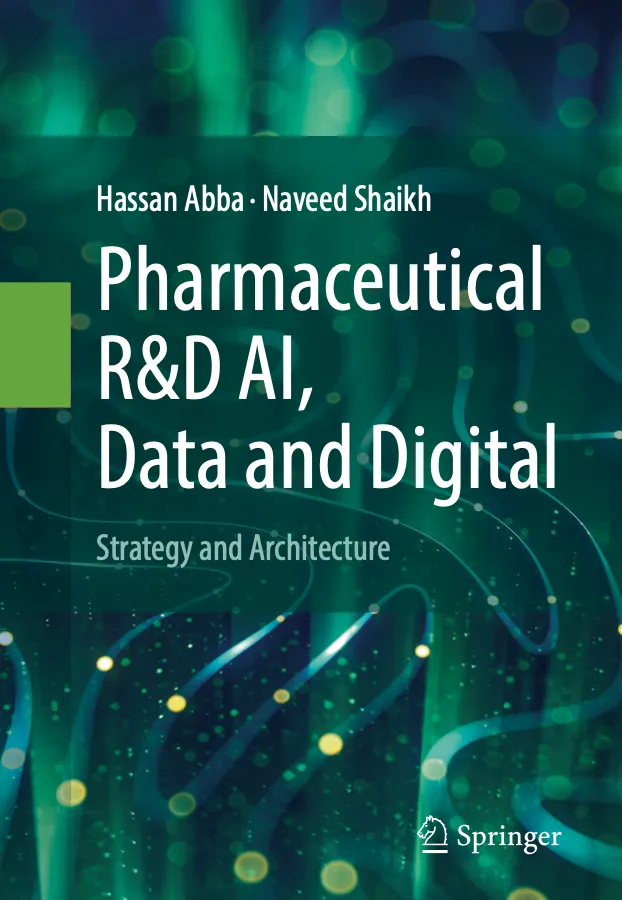
Front cover: the title set over a deep green-teal field scattered with points of light and flowing filaments, with the Springer imprint. Back cover: the book's description on a flat spruce-green field, with the ISBN and Springer imprint.

The book · Forthcoming

Pharmaceutical R&D AI, Data, and Digital

Strategy and Architecture

Why we wrote it

Advances in data, artificial intelligence, and digital technologies are transforming pharmaceutical R&D — yet they are often presented separately from the scientific and operational processes that bring new medicines to patients. This book brings these perspectives together.

The framework

Every domain, through three lenses

Across the book, each R&D domain is examined the same way — so the science, the business processes and the architecture are read together, not in isolation.

  1. 01 Science

    The biology, chemistry and scientific methods behind each domain.

  2. 02 Business Processes

    How the work is actually carried out, end to end.

  3. 03 Architecture

    The data, AI and digital systems that support it.

End to end

The pharmaceutical R&D journey

From the earliest biological target through development, approval and real-world patient safety — the whole value chain, in one book.

  1. Target Discovery
  2. Drug Discovery
  3. Pre-clinical
  4. CMC
  5. Clinical Trials
  6. Regulatory
  7. Patient Safety

What’s inside

The book in five parts

Nineteen chapters, grouped into five parts.

  1. Part 1

    Context

    Chapter 1 · Context

    Historical Perspective

    This chapter traces how today's drug discovery and development arrived, following four threads that converge on the present.

      • The paradigms of scientific discovery, from empirical observation to theory, computation, and data
      • The four industrial revolutions and how each reshaped industry and the organisation of work
      • The four healthcare revolutions and the shift from communal care to industrialised medicine
      • The evolution of information technology, from vertical integration to specialisation and open standards
      • The growing role of data through the digital age
      • The development of AI in waves, from symbolic reasoning through machine learning and deep learning to generative and foundation models, and the open question of generalisation
      • The technology life cycle, and why established companies are positioned to adopt and scale innovation rather than originate it
      • Small and large molecule therapies, and the emerging modalities and platforms that extend them
      • The move towards precision medicine, supported by biomarkers and diagnostics
      • The rise of digital health and the return of care towards the patient

    Chapter 2 · Context

    Pharmaceutical Companies

    This chapter examines how global companies organise their activities to create value, and how these principles apply to pharmaceutical organisations. It explains how operating models, organisational structures, and strategic decision-making support the development and delivery of new medicines.

      • Value chains, operating models, and organisational structures
      • Global integration and local responsiveness
      • Business lifecycles and organisational decision-making
      • The pharmaceutical value chain and supporting business functions
      • Research, manufacturing, commercial operations, and enabling functions
      • The wider ecosystem of organisations supporting pharmaceutical R&D
      • Identifying unmet medical needs and selecting therapeutic strategies
      • Managing R&D portfolios and drug pipelines
      • Investment, productivity, and bringing medicines to market

    Chapter 3 · Context

    Overview of R&D in Pharmaceutical Companies

    This chapter introduces the scientific and organisational foundations of pharmaceutical research and development, explaining why discovering new medicines is fundamentally different from developing products in most other industries.

      • The complexity of living systems and why biology remains difficult to predict.
      • The scientific and engineering approaches used to reduce uncertainty.
      • The pharmaceutical R&D value chain, from target discovery through patient safety.
      • The scientific, technological, and organisational activities that underpin each stage.
      • The complementary roles of science, engineering, and computational science.
      • How mathematical models, simulation, and AI increasingly support discovery and development.
      • The drivers of cost, time, and attrition.
      • Eroom's Law and the productivity challenge facing the industry.
      • Emerging scientific and digital approaches to improving success rates and reducing development timelines.
      • Examples of how leading pharmaceutical companies have restructured R&D to improve decision-making and portfolio performance.

    Chapter 4 · Context

    Overview of R&D AI, Data, and Digital Architecture

    This chapter introduces the architectural foundations that enable AI, data, and digital technologies to support modern pharmaceutical R&D. It explains how enterprise architecture provides the structure through which scientific, operational, and computational capabilities are integrated across the R&D lifecycle.

      • Characteristics that distinguish pharmaceutical R&D from other industries.
      • Transition from traditional operating models towards digitally enabled, data-centric organisations.
      • Layered architecture comprising Systems of Record, Data, and AI & Analytics.
      • Complementary roles of operational systems, connected data, and computational methods.
      • Differing architectural requirements for scientific exploration and regulated drug development.
      • How flexibility, governance, and standardisation are balanced across the R&D lifecycle.
      • Principles of data-centric architecture, semantic continuity, and the information model.
      • Vertical and horizontal data flows that connect scientific and operational evidence across the enterprise.
      • Platform thinking as the mechanism for delivering reusable capabilities at scale.
      • How research, development, data, and AI platforms underpin the architectural layers and enable innovation across pharmaceutical R&D.
  2. Part 2

    End-to-End

    Chapter 5 · End-to-End

    Precision Medicine

    This chapter is organised around three questions:

      • The evolution of medicine from clinical experience through evidence-based population guidelines to molecular-level patient stratification
      • Disease subtyping through molecular profiling, clinical phenotyping, and lifestyle data
      • The role of biomarkers in identifying which patients belong to which subtype and predicting treatment response
      • Tailored treatments that intervene at progressively deeper levels of biology, from blocking proteins to correcting genes to engineering living cells
      • Cell and gene therapy as an entirely different operational model, in which each dose is manufactured for a single named patient
      • The vein-to-vein process that coordinates hospitals, logistics providers, and manufacturing facilities across global distances
      • Companion diagnostics and their role in linking drug development to patient selection
      • The shift from blockbuster to niche-buster business models and the role of population biobanks in generating the datasets precision medicine depends on
      • The feedback loop connecting external research, pharmaceutical R&D, and clinical practice
      • Integrative analysis that combines molecular, clinical, imaging, and EHR data into patient-level stratification
      • Interoperability standards that enable data to flow between biobanks, pharmaceutical companies, and hospitals
      • Cell Orchestration Platforms and Control Towers that coordinate the batch-of-one manufacturing model for cell therapies

    Chapter 6 · End-to-End

    Portfolio Management

    This chapter is organised around three questions:

      • drug development is characterised by long timelines, high costs, and high attrition
      • value is probabilistic and realised over extended time horizons
      • assets cannot be evaluated in isolation and need be managed as part of an interdependent portfolio
      • development timelines needs to align with loss of exclusivity and evolving competitive dynamics
      • the operating model connecting therapeutic areas, shared functions, and project teams
      • governance forums and stage-gate decision-making
      • decision artefacts (CDTP, TPP, and TPL) that define progression criteria at each stage
      • probability-based evaluation and risk-adjusted valuation (eNPV)
      • portfolio balancing, resource allocation, and lifecycle evolution
      • operational systems capturing scientific, clinical, regulatory, and financial data
      • integration layers connecting these systems into a coherent data environment
      • modelling and simulation for portfolio scenario evaluation
      • dashboards and decision-support tools used in governance forums
      • emerging AI capabilities for forecasting and decision support

    Chapter 7 · End-to-End

    Pharmaceutical R&D Laboratories

    This chapter is organised around three questions:

      • laboratories combine scientific expertise, instrumentation, automation, and operational controls to generate experimental evidence
      • analytical, biological, and high-throughput platforms support different forms of experimental work across pharmaceutical R&D
      • quality frameworks ensure that laboratory data remains reproducible, traceable, and suitable for scientific and regulatory use
      • Electronic Laboratory Notebooks (ELNs), Laboratory Information Management Systems (LIMS), and Scientific Data Management Systems (SDMS) as the core laboratory systems of record
      • how these platforms collectively manage experimental context, sample traceability, and raw analytical evidence
      • how laboratory systems integrate with instruments, workflow orchestration platforms, and downstream analytical environments to create structured and computationally accessible laboratory data
      • the Lab-in-the-Loop concept, where wet-laboratory experimentation and computational analysis operate as continuous feedback cycles
      • optimisation approaches that guide experimental selection and execution
      • Self-Driving Laboratories (SDLs), including their operational architecture, autonomy levels, and current limitations
      • how laboratories are evolving into integrated scientific and digital platforms that accelerate experimental learning and improve the efficiency of scientific discovery
  3. Part 3

    Research

    Chapter 8 · Research

    Target Discovery

    This chapter is organised around three questions:

      • The biological basis of disease at the molecular level: genes, proteins, pathways, and networks
      • What makes a protein "druggable" versus "undruggable"
      • The five criteria for evaluating a target: disease linkage, druggability, safety, tractability, and competitive landscape
      • Why complex diseases demand network-level thinking rather than single-target approaches
      • Target identification: from disease biology hypothesis to molecular candidate, using genomics, proteomics, and functional screening
      • Target validation: confirming that modulating the target produces therapeutic benefit across in vitro, ex vivo, and in vivo models
      • Structural characterisation: determining the 3D shape of the target as the bridge to drug design
      • Prioritisation and selection: scoring, trade-offs, and the go/no-go decision that determines everything downstream
      • Genomics and multi-omics data platforms at population scale
      • Computational biology and bioinformatics infrastructure: pipelines, HPC, and cloud
      • Data integration and knowledge representation: connecting fragmented biological knowledge into queryable systems
      • AI and machine learning across the workflow: from literature mining to protein structure prediction
      • Laboratory informatics: closing the loop between computational prediction and experimental validation
      • Synthesising multi-dimensional evidence into actionable target nominations

    Chapter 9 · Research

    Small Molecule Drug Discovery

    This chapter is organised around three questions:

      • Physical and chemical properties that define small molecule drugs
      • How molecular structure determines biological activity, selectivity, and drug-like behaviour
      • Chemical strategies for creating and exploring molecular diversity: medicinal chemistry, natural products, and combinatorial chemistry
      • Lead identification through target-based and and empirical approaches
      • Lead optimisation through iterative Design-Make-Test-Analyse (DMTA) cycles
      • Supporting processes: compound management and assay development
      • Laboratory instrumentation and informatics that generate and manage experimental data
      • Machine-readable molecular representations that feed computational algorithms
      • Computer-aided drug design: structure-based and ligand-based approaches
      • AI and machine learning applied to virtual screening, molecular generation, property prediction, and synthesis planning
      • Closed-loop automation and the trajectory toward self-driving laboratories

    Chapter 10 · Research

    Large Molecule Drug Discovery

    This chapter is organised around three questions.

      • The main biologic modalities, from monoclonal antibodies to cell and gene therapies, and how they achieve therapeutic activity
      • Why molecular complexity, heterogeneity, and dependence on living production systems set biologics apart from small molecules
      • Developability, stability, and manufacturability as constraints that must be balanced alongside efficacy and safety
      • Analytical characterisation, translational models, and the computational methods used to engineer candidates
      • Target discovery and the antibody discovery platforms used to generate hits
      • Lead optimisation through humanisation, affinity maturation, and stability engineering within Design-Make-Test-Analyse (DMTA) cycles
      • Cell line and process development that establish scalable manufacturing
      • The link between discovery and Chemistry, Manufacturing, and Controls (CMC) activities
      • Laboratory systems of record and the automation platforms that generate experimental data
      • Scientific data platforms that integrate sequence, structural, assay, and process data
      • Computational biology and protein modelling environments
      • Machine learning and generative AI across sequence optimisation, developability prediction, and closed-loop lead optimisation
  4. Part 4

    Development

    Chapter 11 · Development

    Drug Product Development

    This chapter is organised around three questions:

      • the physicochemical properties of the active pharmaceutical ingredient constrain formulation options
      • formulation design determines how the drug is delivered, absorbed, and stabilised
      • engineering principles translate formulation behaviour into manufacturable processes
      • Quality by Design provides a structured framework linking product requirements to material attributes and process parameters
      • preformulation and early development as the starting point for feasibility
      • formulation development as an iterative process shaped by emerging data
      • differences between small molecules and biologics in formulation and manufacturing
      • process development, scale-up, and technology transfer as the transition to controlled production
      • clinical supply manufacturing as the interface with trial execution
      • how formulation, manufacturing, and analytical data form the CMC evidence base for regulatory submissions
      • the role of systems of record, execution systems, and quality systems in capturing and governing data
      • CMC regulatory submission architecture aligned to CTD Module 3
      • data integration through CMC data hubs and CMC-specific unified data models (CMC-UDM)
      • structured content and data management (SCDM) as a shift from document-centric to data-centric workflows
      • emerging capabilities such as digital twins and agentic systems

    Chapter 12 · Development

    Pre-clinical Animal Studies

    This chapter is organised around three questions.

      • pharmacodynamic, pharmacokinetic, and toxicological evidence together form the core of every Investigational New Drug application
      • study design, control of bias, and the distinction between exploratory and confirmatory studies determine the reliability of evidence
      • a structured sequence of non-clinical safety studies must remain aligned with the level of intended human exposure as development progresses
      • selection of animal models, based on target biology and physiological relevance shapes study outcomes
      • the translational gap between animal and human studies continues to shape the field, alongside increasing use of non-animal approaches
      • the regulatory and ethical framework
      • the sequence of activities from study planning and protocol development, through dosing and observations, to post-study analysis and statistical interpretation
      • preparation of the dossier for regulatory submission
      • vivarium management, the role of contract research organisations, and the data governance challenges associated with distributed programmes
      • study management platforms that coordinate study design, execution, data transformation, and reporting
      • laboratory systems of record and their role in compliant data capture
      • vivarium information systems that support animal management and environmental monitoring
      • applications of artificial intelligence and machine learning in behavioural analysis, digital pathology, and predictive modelling
      • the progression towards data-centric regulatory submissions and data governance requirements that shape the architecture

    Chapter 13 · Development

    Clinical Trials and Operations

    Clinical trials are both a scientific experiment and a complex operational enterprise. This chapter is organised around three questions that follow from that dual nature:

      • Trial objectives, phases, endpoints, randomisation, and control groups
      • The design families, from traditional through adaptive to master protocols, and the use of simulation to evaluate them
      • Statistical reasoning, evidence hierarchies, and the ethical and regulatory principles that govern research in human participants
      • Decentralised trials and digital health as emerging influences on trial design
      • Operationalising the protocol, and the feasibility and planning that precede a study
      • Study start-up, conduct, and close-out across globally distributed sites
      • Patient recruitment and retention, data capture, and risk-based monitoring
      • The operating model that connects sponsors, sites, and contract research organisations
      • The operational, system-of-record, and analytical layers that support the trial lifecycle
      • How clinical data flows from start-up through conduct to close-out, and the standards that structure it
      • The transformation of captured data into the datasets, analyses, and reports that form regulatory evidence
      • Emerging patterns: protocol digitisation, real-world and digital health data, AI-augmented operations, and continuously learning trial systems

    Chapter 14 · Development

    Regulatory Affairs

    This chapter is organised around three questions:

      • Regulatory approval as delegated authority, granted on a judgement of evidentiary sufficiency under uncertainty
      • How claims are bounded through the indication, population, dosing, and labelling
      • Why authorisation is conditional, time-bound, and revisable across the product lifecycle
      • How advances in regulatory science widen the evidence that can support a decision, from biomarkers to modelling and real-world evidence
      • The regulatory lifecycle from early development strategy through submission, review, and post-authorisation management
      • Regulatory pathways and the global and local operating models that span jurisdictions
      • Reliance and recognition as mechanisms that coordinate and accelerate decisions across authorities
      • Regulatory affairs as the integrator that aligns internal evidence generation with external obligations
      • Regulatory intelligence, strategy and planning, and regulatory information management as core capabilities
      • Structured content authoring and the standards that make regulatory information traceable, versioned, and reusable
      • The shift from document-centric submissions towards data-centric exchange with health authorities

    Chapter 15 · Development

    Patient Safety

    This chapter is organised around three questions:

      • Patient safety and pharmacovigilance, and how safety monitoring shifts from clinical development to routine use
      • The probabilistic, incomplete, and evolving nature of safety knowledge, and the distinctions between hazard and risk, and between an adverse event and its cause
      • The biological mechanisms through which medicines cause harm, from on-target toxicity to idiosyncratic reactions
      • Causality assessment and the science of pharmacovigilance
      • Case management, from individual case safety reports through validation, medical review, and regulatory reporting
      • Signal management, the detection, validation, and assessment of potential new risks across aggregated data
      • Risk management, translating confirmed signals into labelling changes, risk minimisation, and other regulated actions
      • Coordination of pharmacovigilance across national, regional, and global levels
      • The safety database and case management system as the operational system of record
      • Analytical platforms for signal detection, and the control platforms that govern risk actions
      • Shared terminology and data standards that enable interoperability across systems and authorities
      • Artificial intelligence as an augmentation layer across ingestion, signal prioritisation, and decision support
  5. Part 5

    AI, Data & Digital

    • R&D Strategy and Architecture

    Chapter 16 · AI, Data & Digital

    Digital Systems of Record

    The chapter is organised around four questions.

      • What distinguishes an operational system of record from the analytical store that later reads its data
      • How the digitisation of R&D turned paper and spreadsheets into systems that capture data as work happens
      • The principal classes of system across the R&D value chain, and where the architecture of each is described
      • Why the structure, identity, and integrity established at the point of capture set the ceiling on what every later layer can achieve
      • The GxP framework, and how regulatory exposure varies across the R&D lifecycle
      • Data integrity and the ALCOA+ principles, established at the point of capture
      • Computer system validation and the electronic-records regulations that govern regulated systems
      • Audit trails, electronic signatures, and the long-term retention of records
      • The character of operational data, and why it is captured differently from how it is analysed
      • System-to-system integration, from point-to-point connections to the operational data hub
      • Mastering the entities that recur across systems, beginning with the compound
      • Capturing data in a reusable state at source, and the handoff to the analytical data layer
      • Building, buying, or configuring R&D systems, and the validation cost of each
      • Consolidation against best-of-breed, and its consequences for integration and mastering
      • The registry that records the application estate, the operational counterpart to the data catalogue and the model registry

    Chapter 17 · AI, Data & Digital

    Data Strategy and Architecture

    This chapter is organised around four questions:

      • Data as an asset whose value compounds through reuse across the R&D lifecycle
      • The characteristics that distinguish R&D data: modality diversity, regulated longevity, provenance as an obligation, and a federated ecosystem of internal and external contributors
      • How the shape of the data shifts across the lifecycle, from high-volume research data to document-centric development data
      • The cost an organisation pays when data remains fragmented
      • Why a federated operating model fits the distributed reality of R&D better than a central monolith
      • The four principles of data-product thinking: domain ownership, data as a product, a self-service platform, and federated governance
      • The role of FAIR principles and regulatory data integrity as design commitments
      • Where federation gives way to centralised backbones
      • The self-service data platform, examined capability by capability: ingestion, storage, the semantic layer, master and reference data, lineage, quality, and access
      • The architectural patterns that compose the platform: relational warehouses, data lakes, the lakehouse, and supporting designs
      • The boundary at which the data architecture delivers data to AI and analytics
      • Assessing data maturity and sequencing the work
      • Worked data products that cross domain boundaries
      • Organisation, roles, and the indicators that show the strategy is working

    Chapter 18 · AI, Data & Digital

    AI and Analytics Strategy and Architecture

    The chapter is organised around four questions.

      • Type of work that AI is directed at, which shifts from novelty in research to optimisation in development, with a translational bridge between them
      • Classes of method, from established predictive models through foundation models, generative design, and agents, each grounded in the tasks of the R&D domains
      • What is proven in production and what remains emerging
      • Analytical and machine-learning platform, and what it consumes from the data layer
      • Model lifecycle, and how it changes for foundation models and generative systems
      • Serving, retrieval, and agentic infrastructure that reasons over the connected data fabric
      • Evaluating and monitoring models whose ground truth is itself uncertain, and the compute that underpins all of it
      • AI operating model, from a central centre of excellence to a federated capability
      • Choice to build, buy, or adapt a model, and what decides it
      • Path from pilot to production, and why much of AI use cases fail to reach production
      • Responsible AI principles applied to the particular demands of drug research
      • Governing AI under regulatory expectations, with controls scaled to the context of use
      • Measuring whether AI changes how well and how quickly R&D decisions are made

Who it’s for

Written across the disciplines

For those shaping how medicines are discovered, developed and delivered across the pharmaceutical industry.

  • Scientists
  • Technologists
  • Architects
  • Leaders